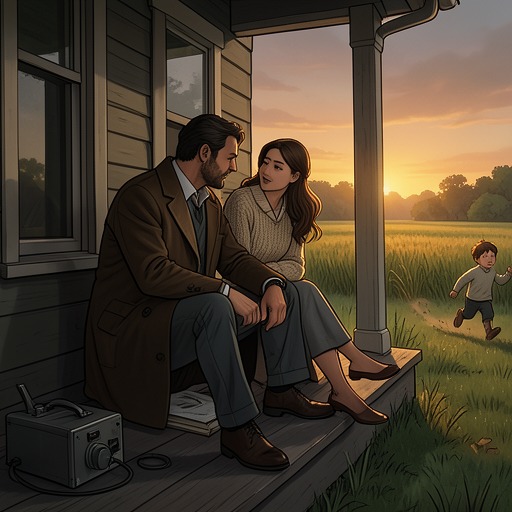
Alex’s short story about the boy with wings
People We Meet on VacationAlex Nilsen’s short story about a boy born with wings is a nine-page work whose quiet ending changes how Poppy Wright understands her closeness to its author. The boy is told throughout his life that his wings mean he should fly; when he finally jumps, he falls, breaks his legs and wings, and heals with the bones left misshapen. Only when other people stop insisting that he must have been born to fly does he become happy. For Poppy, reading this story is not simply an encounter with Alex’s writing: it brings her to tears and makes her feel, for the first time, less alone in the separation between one person’s inner life and another’s.
Sharing the story
Back at the apartment, Poppy asks when Alex will let her read the short stories he has been working on. He resists because he would be embarrassed if she disliked them. Poppy counters that his acceptance into an excellent MFA program is evidence of his ability, and that if she judges the stories badly, she must be wrong. Alex turns her reassurance around: if she dislikes the writing, then the university has made a mistake. His reluctance makes the reading an act of trust as well as a request for an opinion; he is especially uneasy about watching her react. He agrees to share the story only after asking her to read while he is in the shower.
Poppy jokes that she could read a novel during the length of an Alex Nilsen shower, and he throws a pillow at her before going into the bathroom. The teasing gives way to a private encounter with the work itself. The story is only nine pages long, but it contains a complete arc: a boy is assigned an expectation because of his body, fears acting on it, attempts to meet it, and suffers a lasting physical injury. Alex returns from the shower to find Poppy crying. Her response arrives before she can explain it, and the contrast between their ordinary joking and her sudden emotion marks the story as a vulnerable disclosure neither of them had fully anticipated.
The winged boy’s story
The boy’s wings are treated by the people around him as a promise and a directive. They repeatedly tell him that he ought to fly, while he remains afraid to try. When he finally jumps from a two-story roof, the expected transformation into flight does not occur: he falls and breaks both his legs and his wings. The injuries are not corrected or reset. As he recovers, his bones heal in their misshapen form, leaving the consequences of the fall in place rather than restoring him to an imagined ideal.
The ending turns on a change in other people’s expectations, not on the boy proving that they were right. They stop telling him he must have been born to fly, and he is finally happy. The story therefore connects bodily difference with the pressure to make that difference fulfill a role assigned by others. Its resolution does not depend on the boy becoming a successful flyer or having his injuries undone; instead, the demand itself falls away. The evidence does not establish that Alex intended the tale as a direct account of his own life, and its significance for Poppy is not reducible to a single explanation. What is clear is that the ending affects her intensely, even though she cannot entirely say why.
Poppy’s response
When Alex asks what is wrong, Poppy says, “I don’t know. It just speaks to me.” Alex chuckles, taking the remark as a joke about a gallery salesperson who had tried to sell them a bear sculpture for twenty-one thousand dollars. This time, however, Poppy is not referring to the sculpture. She is thinking of Julian’s view that art either makes a person feel something or it does not. Her tears are immediate, but their cause remains difficult for her to articulate even to Alex.
The story reaches Poppy through a fear she remembers from childhood. She used to panic at the thought that she could never be anyone else: she would have to live inside her own body and could never truly know another person from within. The thought left her lonely and desolate. When she told her parents, she expected them to recognize what she meant, but they did not; her father instead asked who else she thought about being. The fear lessened as she grew older, yet the underlying question returned from time to time: how could anyone stop feeling lonely if no one could know them all the way, or look directly into another person’s mind?
Connection and significance
Reading Alex’s story gives that old fear a new counter-image. Poppy feels as if she is no longer confined to her body, as though a bubble stretches around her and Alex. Within it, they remain two distinct, differently colored forms, like globs in a lava lamp, but they can mix and move around one another freely. The image does not claim that they become the same person or gain complete access to each other’s minds. Its force lies instead in the possibility of closeness across that difference.
Poppy cries from relief: with Alex in her life, she believes she will never again be as alone as she was during those long nights as a child. The story’s importance thus exceeds its plot and Alex’s anxiety about being judged. By letting Poppy read it, he shares work he had kept private; by responding so strongly, she discovers that art can give shape to a feeling she has struggled to explain. The winged boy’s release from other people’s expectations and Poppy’s sense of connection are not presented as identical experiences. Their resonance makes the story a turning point in how she feels the bond between herself and Alex: not the end of separateness, but a form of companionship that makes separateness feel bearable.